When we think of Hanuman Jayanti, we often visualize saffron flags, the smell of boondi laddus, and the thunderous chanting of the Hanuman Chalisa. To many, these are simply beautiful traditions passed down through generations. However, as we observe the festival on Thursday, April 2, 2026, a new trend is emerging among the youth and wellness communities. People are moving beyond “blind faith” and beginning to uncover the actual scientific benefits of Hanuman Jayanti rituals.
Whether it is the physics of sound frequencies or the biological impact of fasting, the “Andhabiswas” (superstitions) of the past are being rebranded as the “Life Hacks” of the future.
1. The Acoustic Science of Chanting
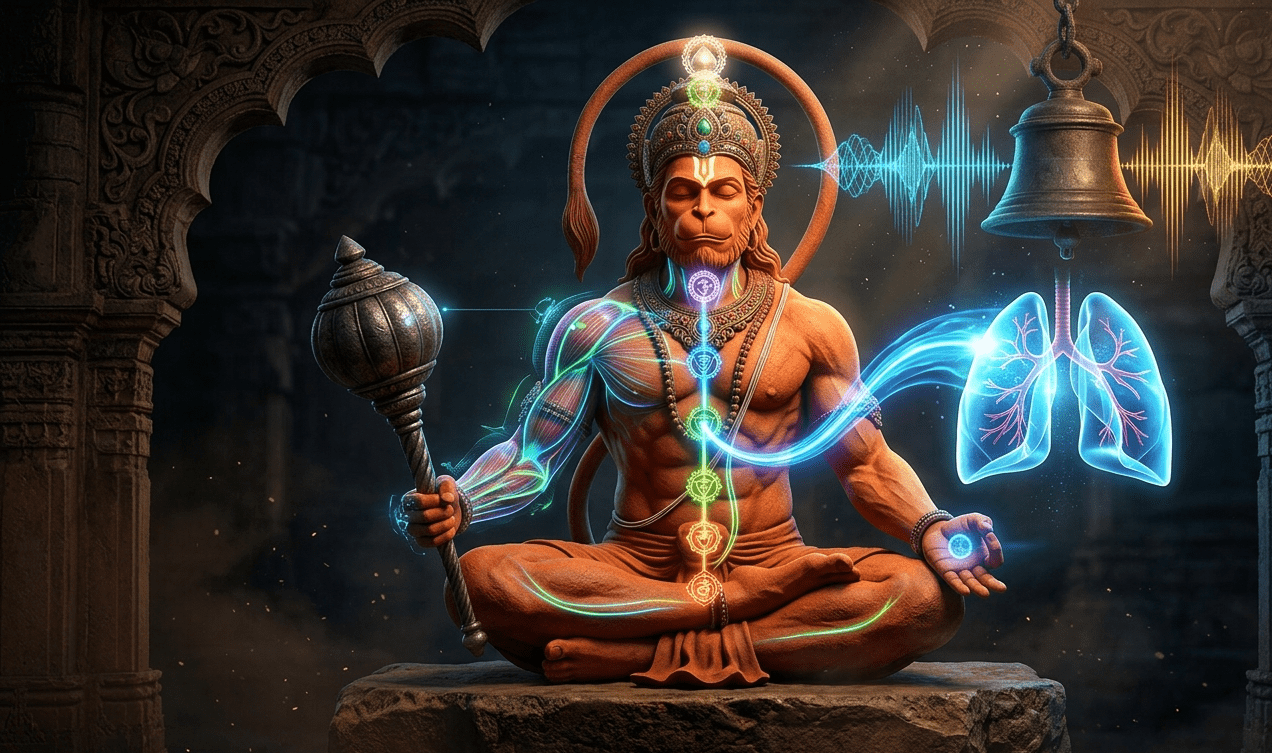
One of the most prominent scientific benefits of Hanuman Jayanti rituals lies in the power of sound. The Hanuman Chalisa is composed in a specific rhythmic meter that, when recited aloud, creates a series of low-frequency vibrations.
Modern neuro-acoustic studies suggest that rhythmic chanting at these frequencies can sync the left and right hemispheres of the brain. When thousands of people chant “Jai Hanuman” in unison, the resulting resonance isn’t just a social experience; it is an acoustic “reset” for the nervous system. This is why many devotees report a feeling of “sudden mental clarity” after a temple visit—it is the biological result of sound-wave therapy.
2. The Vayu Element: Breath and Bio-hacking
Lord Hanuman is known as Pavanputra (Son of the Wind). While this is a mythological title, it also points toward the scientific benefits of Hanuman Jayanti rituals related to respiratory health.
Ancient Hanuman worship often involves “Pranayama” or controlled breathing. In 2026, with rising urban pollution and respiratory stress, the ritualistic focus on “Vayu” (air) encourages devotees to practice deep-breathing exercises. Chanting the Bajrang Baan, which requires long, sustained exhales, naturally increases lung capacity and oxygenates the blood. By honoring the “God of Wind,” we are essentially practicing an ancient form of pulmonary strengthening.
3. Red and Orange: The Psychology of Color
If you visit a temple during the festival, you are surrounded by shades of vermilion (Sindoor) and bright orange. While this is a traditional offering, there are psychological and scientific benefits of Hanuman Jayanti rituals tied to color therapy.
Orange is a high-energy color on the visible spectrum. It is scientifically proven to stimulate the “sacral chakra” area, which governs creativity, physical energy, and courage. In a world where mental fatigue and “burnout” are common, surrounding oneself with high-vibration colors like orange and red during the festival acts as a psychological stimulant, boosting dopamine and physical alertness.
4. The “Earth Connection” in Prostration
The act of Dandavat Pranam (full-body prostration) is a core ritual. The scientific benefits of Hanuman Jayanti rituals include the physical concept of “Grounding” or “Earthing.”
By placing the forehead, chest, and palms directly in contact with the temple floor (usually made of natural stone or marble), the body discharges excess static electricity into the earth. This physical “discharge” is linked to reduced inflammation and better sleep cycles. Our ancestors may not have used the term “electromagnetic balance,” but they understood that connecting with the earth was essential for vitality.
5. Why Fasting on Tuesday and Thursday Works
Hanuman Jayanti 2026 falls on a Thursday, a day often associated with Guru and wisdom, but Hanuman is traditionally worshipped on Tuesdays. The scientific benefits of Hanuman Jayanti rituals involving fasting (Vrat) are now being validated by modern “Intermittent Fasting” research.
By abstaining from salt and heavy grains for 24 hours, the body triggers “Autophagy”—a cellular cleaning process where the body heals itself. Framing this as a religious vow ensures that the “patient” (the devotee) follows the protocol strictly, leading to improved gut health and insulin sensitivity.
6. The 7-Second Temple Bell Reset
Have you ever wondered why temple bells are made of a specific alloy of lead, copper, zinc, and nickel? This is not a coincidence. When struck, a properly crafted bell creates a sharp, echoing sound that lasts for at least 7 seconds.
One of the hidden scientific benefits of Hanuman Jayanti rituals is that this 7-second echo is designed to touch the seven healing centers of the human body. The sound effectively “shuts down” the internal monologue of the brain, forcing the mind into a state of “Sunyata” or zero-thought. In 2026, we call this “mindfulness,” but for centuries, it has just been the sound of the temple.
7. The Physics of the “Gada” (Mace)
Lord Hanuman’s weapon, the Gada, is a symbol of strength. In many Akhadas (traditional gyms) across India, the festival is celebrated with mace-swinging competitions. The scientific benefits of Hanuman Jayanti rituals in this context involve “functional strength training.”
Swinging a mace (Gada) is an offset-loading exercise. Unlike a symmetrical dumbbell, the weight of a Gada is at the end of a long lever, which forces the core muscles and grip strength to work 3x harder. Modern athletes are now rediscovering “Macebell training” as a way to fix shoulder mobility and core stability—something Hanuman devotees have been doing for millennia.
8. The Sindoor Offering: A Natural Antiseptic?
The tradition of offering Sindoor (vermilion) mixed with oil to the idol of Hanuman is often seen as purely symbolic. However, traditional Sindoor was made of turmeric and lime, sometimes containing traces of mercury or lead (in older times).
The scientific benefits of Hanuman Jayanti rituals involving these elements often had a medicinal origin. Turmeric is a known anti-fungal agent. In ancient times, the “Prasad” or the oil from the idol was often used as a topical treatment for skin ailments or muscle pain. While we must be careful with modern synthetic colors, the original ritual was rooted in the chemistry of healing.
9. Mental Resilience and the “Super-Hero” Archetype
From a sociological perspective, the scientific benefits of Hanuman Jayanti rituals include the “Self-Efficacy” boost. By meditating on a figure of unlimited strength and humility, the devotee undergoes a psychological transformation.
Visualizing Hanuman’s leap across the ocean or his ability to carry a mountain activates the “mirror neurons” in our brain. It shifts the internal narrative from “I can’t” to “It is possible.” This cognitive reframing is a powerful tool against the anxiety and depression that often plague the modern digital worker.
10. Conclusion: The Wisdom of the Ancestors
As we close our celebrations for Hanuman Jayanti 2026, it is clear that these rituals were never meant to be “blind.” They were a sophisticated system of public health, mental hygiene, and physical fitness disguised as religious tradition.
By understanding the scientific benefits of Hanuman Jayanti rituals, we can practice our faith with more than just our hearts—we can practice it with our minds. This Baisakhi and Hanuman Jayanti season, let’s choose to be “Bio-hackers for the Soul.”