If you’re scrolling through your phone at 11 pm, jaw‑clenched, thumb stuck on a feed that never ends, the idea of “just meditate” can feel like a joke.
But for a lot of Gen Z and young adults, meditation and mantras aren’t just “old‑school rituals” anymore. They’re being treated more like mental‑health tools that sit right next to therapy, nootropics, and breathing‑app notifications on the lock screen.
What’s changed?
A lot of young people are no longer asking, “Is this religious?” as much as “Does this actually work for my brain?”
That’s where the science of meditation and mantras meets the tech‑driven mind of youth culture. And one of the juiciest points of overlap is a simple question:
Why 108?
Why do people chant 108 times, use a 108‑bead mala, and frame mantras in threes?
Turns out, 108 isn’t just a mystical number—it sits at the crossroads of geometry, astronomy, anatomy, and brain rhythm in a way that modern science is starting to validate quietly.
Meditation, Mantras, and the “Chemistry of Quiet”
Meditation, at its core, is practised attention training.
You’re not trying to “stop thoughts”—you’re trying to notice patterns, slow the feedback loop, and give your nervous system a break from the 24/7 internet‑firehose.
Modern neuroscience and psychology have started to map what happens when you sit still and repeat a mantra:
- Reduced amygdala activity – the brain’s “alarm center” linked to fear and anxiety tends to calm down.
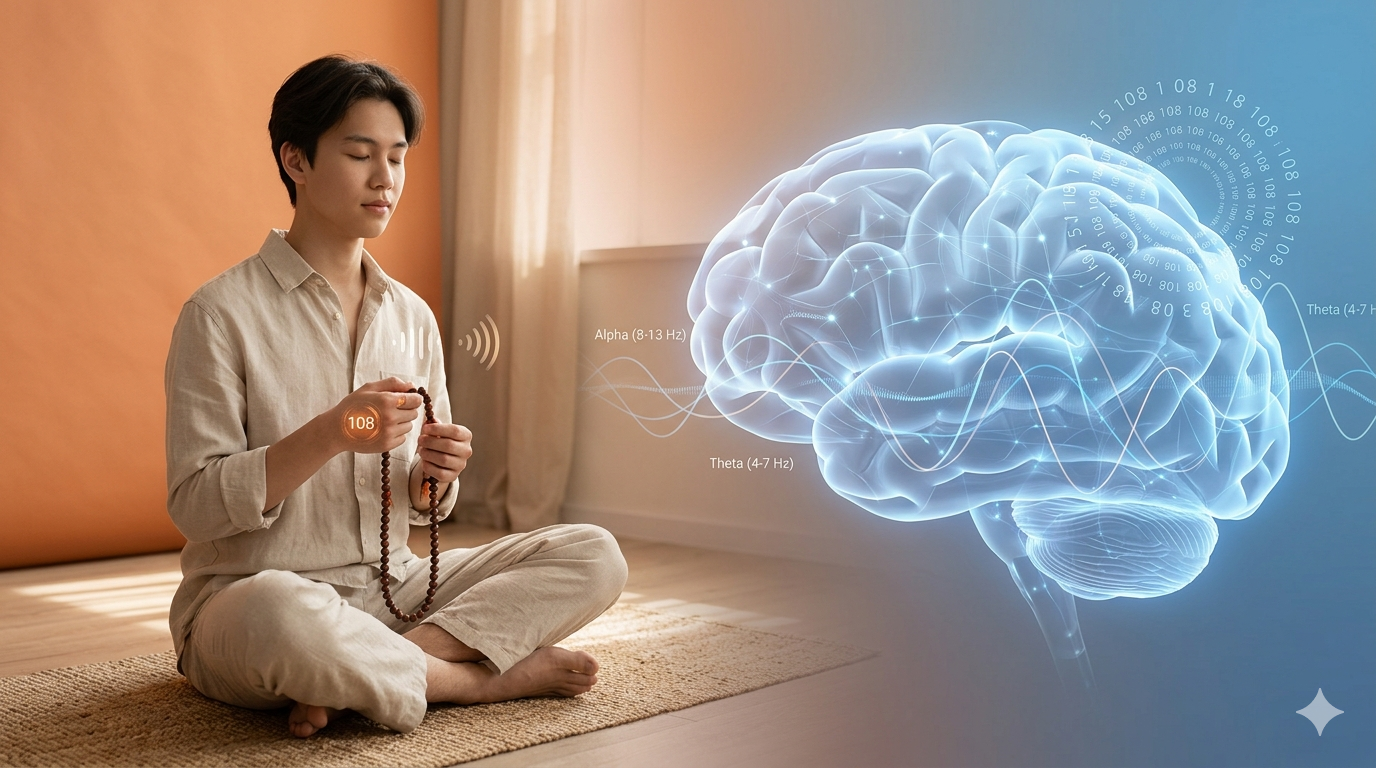
- Increased alpha and theta waves – slower, more relaxed brain waves associated with daydreaming, creativity, and light trance.
- Lowered cortisol levels – the stress hormone that spikes during doom‑scrolling and late‑night overthinking.
- Strengthened default‑mode network modulation – your brain’s “self‑narrating” circuit learns not to spin as wildly.
None of this is magic. It’s neuroplasticity in slow motion.
When you repeat a sound (mantra) or a breath pattern, you’re literally training neural pathways to default to a calmer, more focused state—similar to how gaming trains reaction time or coding trains pattern recognition.
This is why more and more apps are packaging “meditation‑as‑performance‑enhancement” instead of “spiritual‑guilt‑trip”:
- “Focus for 10 minutes, then hit the gym or the laptop.”
- “Recover from burnout like a pro‑athlete.”
- “Clear mental RAM before a big decision.”
From a youth‑tech perspective, meditation starts looking less like religion and more like mental firmware—a routine update for a brain that’s running on too many open tabs.
Mantras as Brain Hacks, Not Just Prayers
A mantra is a sound pattern that you repeat.
In youth‑centric circles, the religious baggage is lightening; the focus is shifting to “How does this sound affect my state?”
Some key angles:
1. Repetition and brainwave entrainment
When you repeat a mantra at a steady pace, two things can happen:
- Your breathing naturally slows and evens out.
- Your brainwaves start to sync with the rhythm of the repetition.
This is a basic form of entrainment—the same way your mind can sync with a beat in a song, it can sync with the loop of a mantra.
Theta and alpha waves (4–8 Hz and 8–12 Hz, roughly) are especially tied to relaxation, introspection, and light trance. Many traditional mantras converge naturally around that range when chanted slowly.
From a tech‑y perspective, you can think of a mantra as a low‑code algorithm for calming your own brain—no lab, no drugs, just you, your breath, and a sound.
2. The “sound as a filter” idea
You can’t actually stop thoughts.
But you can replace chaotic mental noise with a simple, predictable sound.
Chanting “Om,” “Om Namah Shivaya,” “Ram,” or even a simple “peace” in your head:
- Acts as a background loop your brain can latch onto.
- Makes it easier to notice when your mind wanders (and then gently bring it back).
This is similar to how music or binaural beats work:
- Background noise that blocks unwanted noise.
- A predictable rhythm that organises internal chaos.
For digital‑native youth, this is like switching from a cluttered multi‑tab browser to a single focused window.
3. The body‑sound‑feedback loop
Chanting isn’t just in your head—it’s in your vocal cords, chest, diaphragm, and fingertips (if you’re using a mala).
Repeating a mantra while:
- Breathing deeply from the diaphragm
- Feeling the vibration in the chest
- Touching beads one by one
Turns the practice into a whole‑body feedback system. That’s why:
- Silent mental repetition is good for quick focus.
- Full‑voiced or whispered japa is better for deep emotional reset.
It’s the difference between a text‑only app notification and a haptic, sound‑enhanced alert—the multi‑sensory version leaves a stronger imprint.
Why 108? Beyond Tradition, Into Math and Biology
Now let’s get to the meme‑worthy part: Why 108?
You see it everywhere:
- 108 beads on a mala.
- 108 names of deities.
- 108 warrior chants.
- “Chant 108 times, then you’re done.”
Is it made‑up? Or is there something underneath?
1. 108 in geometry and astronomy
From a number‑nerd perspective, 108 sits at an interesting crossroads:
- 1.08 × 100 – the 108:100 ratio is close to the golden ratio family that appears in spirals, branching, and other natural patterns.
- Diameter to circumference magic – in some Vedic cosmology‑style models, 108 appears in sun–earth–moon geometry (distance or size ratios are approximations, not lab‑perfect, but the pattern is repeated in ancient texts).
- Circle and 360 – 360 ÷ 3.333… ≈ 108; some older Indian systems tied 108 to arc‑minute divisions and celestial cycles.
You don’t need to prove it’s “scientifically sacred.” Just notice: 108 feels like a “round number” but not too round—it’s big enough for a micro‑ritual, small enough to finish in a sitting.
2. 108 and the body
Human‑centric systems also love 108:
- 108 marmas (energy or vital points in Ayurvedic and tantric anatomy).
- 108 breaths per day in some yogic texts (approximate, not literal, but conceptually, it’s 108 × 100‑ish breaths over 24 hours).
- Heart‑breath ratios – some teachers link 108 repetitions of a mantra to one full “cycle” of breath and attention.
From a brain‑science angle, repeating something just long enough to feel it, but not so long that you crash lines up with working memory and attention span—about 5–15 minutes of focused repetition is enough to:
- Induce mild theta‑state.
- Create neural“habituation” to the mantra.
- Give your executive system a “this is safe, we can relax” signal.
108, in practice, is:
- Long enough to train the brain.
- Short enough to feel achievable in a busy day.
It’s less like a divine decree and more like a “minimum viable repetition” trick that ancient sages stumbled onto and kept because it worked.
3. 108 as a ritual “frame”
You could count to 50, 100, or 200.
But 108 has something special: it creates a ritual frame.
- 108 times around a mala gives you a beginning, middle, and end.
- Your brain knows: “I’m doing one cycle, not infinite chaos.”
- When you hit the “guru bead,” it acts like a soft reset signal—you pause, reflect, then either stop or start again.
For digital‑native youth, this is similar to:
- A timer (25 minutes of focus, then a break).
- A tracklist (one playlist, not endless shuffle).
Structure doesn’t kill freedom; it reduces decision fatigue.
Japa Mala: The Analog “App” You Hold in Your Hand
If you think of a mantra as a mental app, then the japa mala is the physical controller.
Why use beads instead of a phone counter?
- No notifications – your thumb is on beads, not a screen.
- Tactile feedback – each bead is a mini “completed” signal.
- Slow execution – you can’t skip ahead like on a progress bar.
- Discrete boundaries – 108 beads = one session.
For a generation that’s tired of endless infinite scroll, the mala offers something absurdly attractive:
A practice that is finite, physical, and offline.
Neuro‑wise, this tactile loop:
- Strengthens the body–mind connection.
- Keeps your fingers busy, not your eyes.
- Acts like a distraction‑dampener that keeps your brain from jumping to the next thought so easily.
It’s like using physical weights instead of a “fitness app” screen:
- The numbers are embedded in the object, not in pixels.
- You’re less likely to cheat.
- The feedback is more real.
Brain Waves, Frequency, and the “Power of Sound”
Now let’s lean into the nerd‑friendly angle you wanted: brain waves, frequency, and sound.
1. Brain‑wave states (simplified)
You don’t need to be a neuroscientist, but a basic map helps:
- Beta waves (13–30 Hz) – active thinking, stress, “I need to reply to this message now.”
- Alpha waves (8–12 Hz) – relaxed, daydreamy, unfocused but calm.
- Theta waves (4–7 Hz) – deep relaxation, light trance, creative flow, “almost asleep but aware.”
Meditation and mantra repetition often push you from frantic beta into relaxed alpha or theta.
Slow chanting or japa:
- Slows your breathing.
- Lowers heart rate slightly.
- Shifts brain‑wave activity toward the alpha–theta zone.
In tech terms:
You’re downloading quieter firmware into your brain.
2. Sound, vibration, and entrainment
Sound is just vibration.
When you chant a mantra rhythmically:
- Your body vibrates at that rhythm.
- Your brain tends to sync with that rhythm.
This is the same principle behind:
- Binaural beats (two tones close in frequency that trick your brain into a third “beat” frequency).
- Isometric audio (steady, slow‑paced tracks used for meditation apps).
A mantra like “Om” (A–U–M) is especially interesting:
- It’s resonant in the chest and head.
- It’s smooth and looping, easy to repeat without strain.
- It’s short but rich—one syllable that can swallow a lot of breath.
Neuro‑sound research is still early, but the pattern is clear:
Repeating a simple, resonant sound at a steady pace helps your brain slow down and stabilise.
Youth, Tech, and the “Validation” Play
Here’s the real reason this angle hits young audiences so hard:
They don’t want religion to be blind belief.
They want it to be “belief with receipts.”
So when you tie 108:
- To math (geometry, ratios),
- To biology (breath, marma points),
- To neuroscience (brain waves, attention, stress),
It stops feeling like “old people stuff” and starts feeling like:
A hack that our ancestors stumbled onto and we’re now finally testing in labs.
That’s why phrases like:
- “Science is just catching up to meditation.”
- “Mantras might be nature’s frequency‑based software.”
- “108 repetitions is the ancient version of ‘do this for 10 minutes’.”
Land so well on Gen Z and early‑20s minds.
They’re already performance‑oriented, tech‑curious, and skeptical of dogma.
But they’re also burnt out, anxious, and open to tools that work—even if they come wrapped in Sanskrit.
How a Youth‑Tech Mind Can Use This
You don’t need to be a monk to benefit from the 108–mantra–meditation combo.
You can treat it like a micro‑protocol:
1. The 108‑rep “mental reset”
- Pick a simple mantra: “Om,” “Om Namah Shivaya,” “Ram,” or “peace.”
- Set a 10–15 minute timer.
- Use a mala or your fingers to count 108 repetitions.
- Focus on:
- Sound.
- Breath.
- Feeling the vibration in your chest.
Use‑case moments:
- Before an exam, interview, or big meeting.
- After a toxic online argument.
- Late at night when your brain is looping.
2. The “3×10⁸” day‑anchor
- 108 in the morning (after waking).
- 108 in the evening (before sleep).
- 108 mid‑day for a “mental water break.”
This mirrors the app‑based “habit‑stacking” logic many apps sell.
3. The tech‑augmented version
If you want to be fully hybrid:
- Use a voice‑memo app to record a short mantra loop.
- Loop it in the background while you stretch, walk, or sit.
- Pair it with a simple breathing app that nudges you every 4 seconds.
You’re not “cheating.” You’re using modern tools to amplify an ancient practice.
FAQs
1. “Is chanting really different from just listening to music?”
It can be, if you’re actively repeating the sound yourself.
Passive listening relaxes you; active repetition trains your attention and body.
2. “Do mantras have to be in Sanskrit? Can I use English?”
The sound pattern matters more than the language.
If you repeat “peace, peace, peace” at a steady rhythm, your brain will still respond.
Sanskrit mantras are useful because they’re already tuned by tradition to be easy to repeat and vocalise well.
3. “Is 108 magic, or is it just a number?”**
It’s mostly a smart, ancient “number that works” rather than a supernatural code.
It’s long enough to feel real, short enough to complete, and sits in patterns that line up with math, body, and ritual.
4. “Can meditation and mantras really help anxiety and ADHD?”
Research shows:
- Meditation reduces baseline anxiety and improves emotion regulation.
- Repeating simple sounds or mantras can anchor attention, which helps ADHD‑style minds.
It’s not a cure‑all, but it’s a free, low‑risk tool that stacks well with therapy, medication, and lifestyle changes.
SEO‑Optimized Meta Tags (Yoast‑Style)
SEO Title (around 55–60 characters)
The Science of Meditation & Mantras: Why 108 Works
Meta Description (around 150–155 characters)
Explore the science of meditation and mantras for the youth and tech‑savvy. Why 108 repetitions, brain waves, and sound frequency make mantras surprisingly effective.
Keywords
science of meditationmantras and brain waveswhy 108 mantrasjapa mala scienceneuroscience of mantras108 beads meaningmeditation for youthGen Z meditationfrequency of sound and brainmantra repetition 108 timespower of sound meditationscience behind japabrain waves and meditationmeditation and technologyyouth mental health meditation
Suggested URL Slug
/science-of-meditation-mantras-108-gen-z
This article blends youth‑tech tone, neuroscience‑lite, and a subtle, non‑preachy take on tradition, so it feels like a smart‑friend explainer rather than a spiritual lecture.