
Have you ever wondered why, on April 14 every year, almost every corner of India erupts in celebration? In Punjab, it is Baisakhi. In Kerala, it is Vishu. In Tamil Nadu, it is Puthandu, and in Bengal, it is Poila Baisakh. To a casual observer, it looks like a massive coincidence. But if you look at the stars, you realize it is actually a masterpiece of ancient physics.
As we approach the festivities in mid-April 2026, the conversation is shifting. People are tired of being told “it’s just tradition.” They want to know the “why.” They want to understand the scientific reason for Baisakhi and Vishu dates that aligns an entire subcontinent to a single moment in time.
The Mesha Sankranti Phenomenon
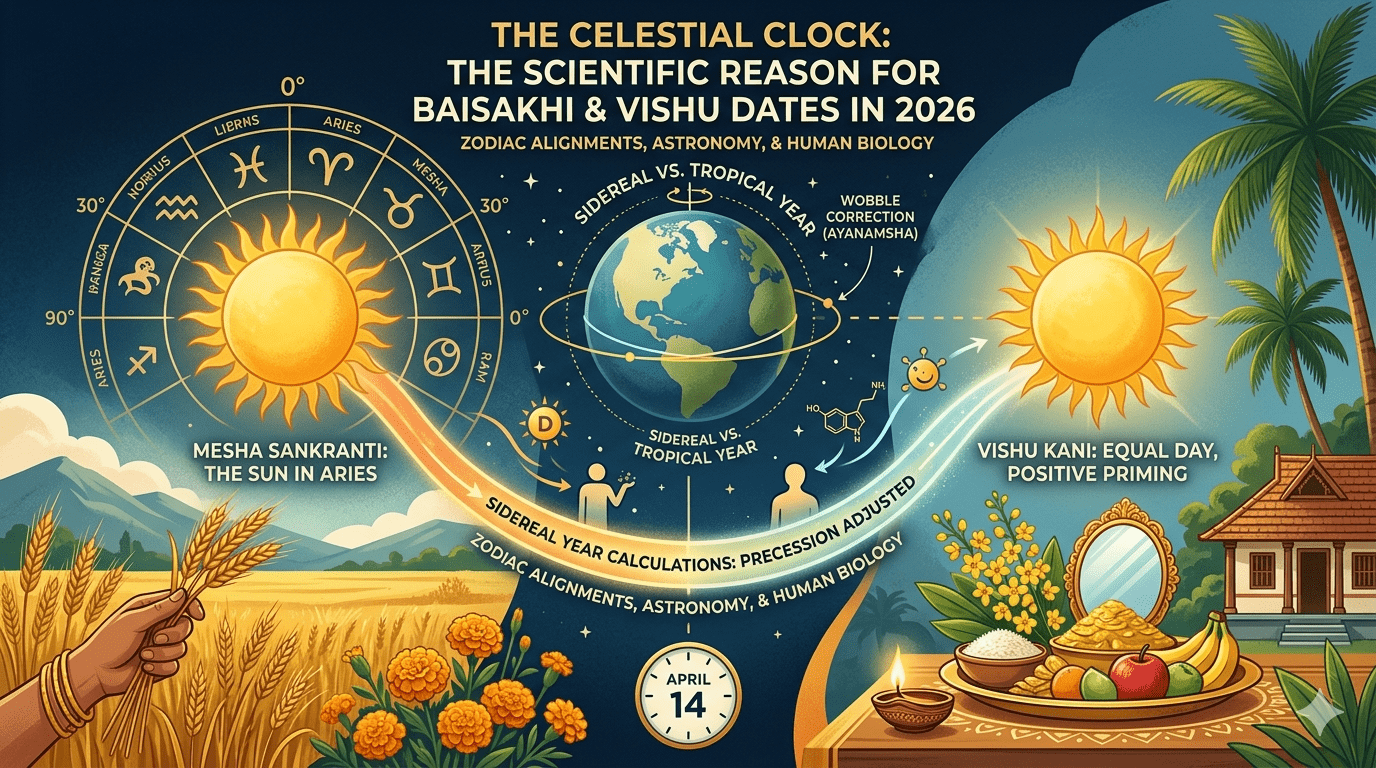
The core scientific reason for Baisakhi and Vishu dates lies in a specific astronomical event called Mesha Sankranti. In the Indian sidereal (Nirayana) calendar, this is the exact moment the Sun leaves the zodiac sign of Pisces and enters the sign of Aries (Mesha).
Unlike the Gregorian calendar, which is purely solar and has a fixed “January 1st” that doesn’t correspond to any celestial event, the Indian New Year is tied to the actual position of the Sun in the sky. When the Sun hits the 0-degree mark of Aries, the “celestial clock” resets. This is the ultimate scientific reason for Baisakhi and Vishu dates—it is a celebration of a planetary transition.
The Sidereal vs. Tropical Year
Why does this happen on April 14 and not the Spring Equinox on March 21? This is where the logic gets deep. Western astrology uses the “Tropical” year, while Indian astronomy uses the “Sidereal” year.
The scientific reason for Baisakhi and Vishu dates being in April is due to the “Precession of the Equinoxes.” Because the Earth wobbles slightly on its axis, the position of the stars shifts by about one degree every 72 years. Ancient Indian astronomers like Aryabhata accounted for this shift (called Ayanamsha). They decided to tie the New Year to the fixed stars (Nakshatras) rather than just the seasons. This ensures that the festival remains anchored to the cosmos, even as the Earth’s tilt changes over thousands of years.
Vishu and the Equal Day/Night Balance
In Kerala, the word Vishu literally translates to “equal.” The scientific reason for Baisakhi and Vishu dates is historically linked to the Equinox—the day when day and night are of equal length.
While the wobbling of the Earth has pushed the actual equinox back to March, the ritual of the Vishu Kani (viewing auspicious items first thing in the morning) is a biological hack. By waking up to bright yellow Kanikkonna flowers (Cassia fistula) and gold during the “equal” point of the year, it balances the circadian rhythm and sets a positive psychological tone for the coming solar cycle.
The Biological Impact of the Solar Peak
As we enter mid-April 2026, the Sun reaches its maximum intensity in the Northern Hemisphere. One scientific reason for Baisakhi and Vishu dates being celebrated now is the impact of Vitamin D and solar energy on the human endocrine system.
After the sluggishness of winter and the transition of spring, the mid-April sun triggers a spike in serotonin. The “harvest” isn’t just happening in the fields of Punjab; it is happening in our bodies. The festivals are a way to channel this sudden surge of solar energy into community bonding and physical activity.
Why Every State Synchronizes
It is a marvel of ancient data networking. Without the internet, how did the Tamils, Mallus, Punjabis, and Assamese all agree on the scientific reason for Baisakhi and Vishu dates?
The answer is the Panchangam. This mathematical manual allowed local priests to calculate the Sun’s entry into Aries with incredible precision. Whether you were in a village in the South or a valley in the North, the math was the same. The scientific reason for Baisakhi and Vishu dates is proof that India was a “mathematically unified” culture long before it was a politically unified one.
The Agriculture-Astronomy Link
You cannot separate the sky from the soil. The scientific reason for Baisakhi and Vishu dates is also rooted in the “Rabi” harvest. In 2026, with climate change shifting weather patterns, these dates act as a stable “environmental marker.”
The grain is dry, the moisture is low, and the solar heat is perfect for processing the harvest. By celebrating on these dates, the community ensures that everyone is synchronized for the most important economic event of the year—the storage of food.
The Physics of the “Vishu Kani” Mirrors
In a traditional Vishu celebration, a mirror is kept in the Kani arrangement. The scientific reason for Baisakhi and Vishu dates rituals involves “Optical Reflection Therapy.”
When you see yourself in a mirror surrounded by light and abundance (fruits, gold, flowers) as your very first sight of the New Year, your brain undergoes a process called “Positive Priming.” It’s a psychological logic that reduces the “scarcity mindset” and prepares the prefrontal cortex for a year of proactive decision-making.
Conclusion: Respecting the Math
As we celebrate Baisakhi and Vishu in 2026, let’s look past the “Andhabiswas” of just doing things because our parents did them. The scientific reason for Baisakhi and Vishu dates is a testament to the fact that our ancestors were master astronomers.
They didn’t just pray to the Sun; they tracked its every degree. They didn’t just celebrate a day; they celebrated a celestial alignment. This April, when you look at the yellow flowers or the golden wheat, remember: you aren’t just following a tradition. You are following the laws of physics.