When people think of Varanasi, images of crowded ghats, smoky evening aarti, and Hindu‑centric riverfronts usually come to mind.
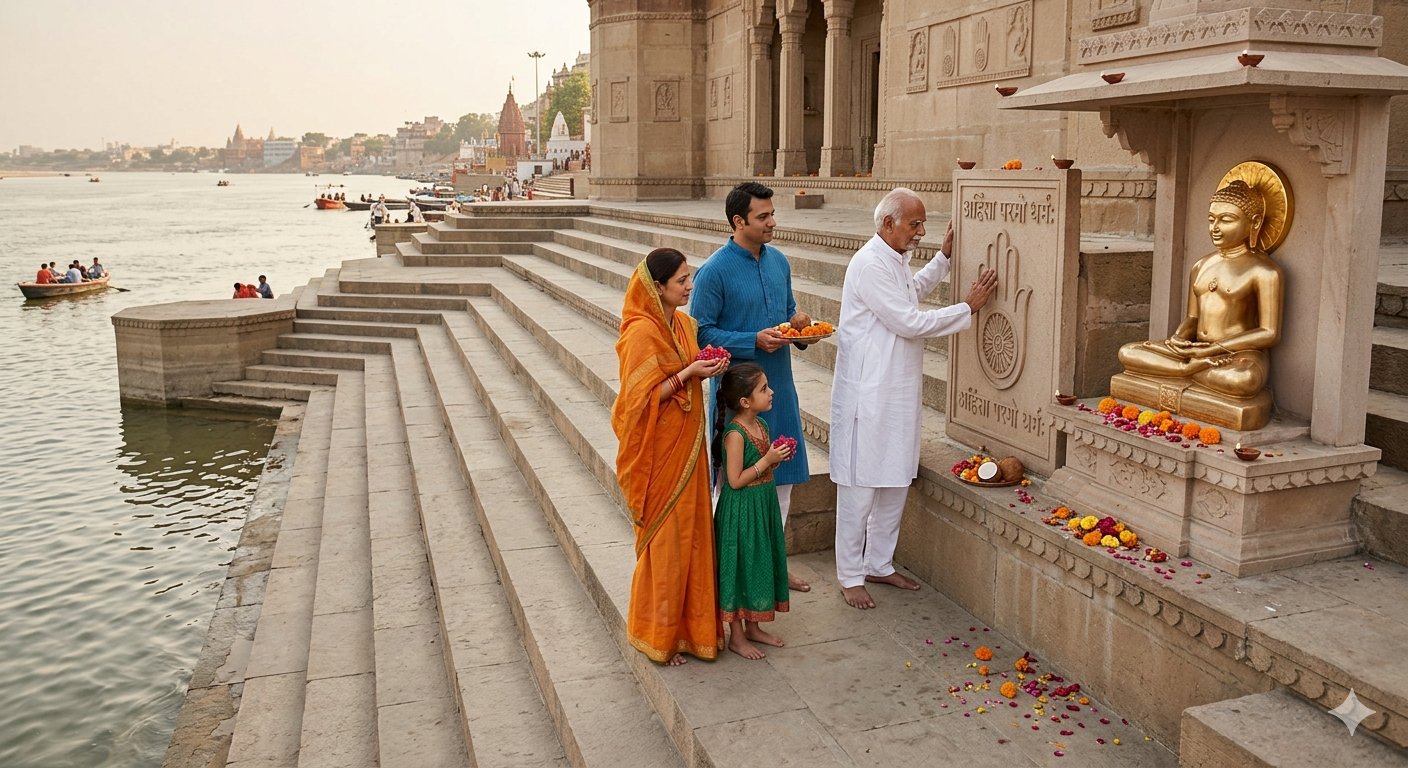
But quietly, beneath that familiar surface, something new is rising along the Ganga: a dedicated Jain space surfaced through the Chandravati Ghat.
On March 24, 2026, the government announced the near‑completion of a massive, eco‑friendly, three‑tier ghat at Chandravati in Varanasi, a locality traditionally linked to the birthplace of the 8th Tirthankar, Bhagwan Chandraprabhu.
This isn’t just another riverside project. It’s being framed as a key Jain‑friendly landmark within Varanasi and positioned as a new stop on the “Jain Circuit” in Uttar Pradesh—aimed at Jain pilgrims, families, and spiritual‑tourism travellers who want more than brief temple visits.
What Is Chandravati Ghat?
Chandravati is a small, culturally dense locality in Varanasi that Jain texts and oral tradition point to as the birthplace of Bhagwan Chandraprabhu, the 8th Tirthankar.
For centuries, Jain visitors have known this place by name, but its physical presence on the spiritual‑tourism map has been subtle.
Until now.
The new Chandravati Ghat is being built as a multi‑tiered, eco‑friendly riverside structure:
- Designed to handle pilgrims comfortably without creating dense crowding.
- Equipped with better paving, lighting, and basic sanitation.
- Integrated with the Ganga riverfront development currently underway in Varanasi.
Instead of being a narrow lane leading to a quiet Jain shrine, Chandravati is now being upgraded into a destination‑style stop where Jain devotees can combine riverfront rituals, prayer, and temple visits in one compact area.
Bhagwan Chandraprabhu and Jain Identity in Varanasi
Varanasi is an unusual city in the Jain imagination.
On one hand, it’s a major Hindu tirtha, famous for temples, rituals, and the constant churn of pilgrims.
On the other, it quietly holds multiple Jain connections,Chandravati is one of the most significant.
Bhagwan Chandraprabhu, the 8th Tirthankar, is part of the Jain narrative that links Varanasi into the broader Jain tirth framework, even if that connection isn’t as loudly advertised as Kashi’s Hindu identity.
For Jain families who travel across states for tirth‑yatra, this makes Chandravati a small but meaningful node—a place where their community history overlays a city better known for someone else’s traditions.
By giving Chandravati its own dedicated ghat, authorities are quietly:
- Validating Jain presence in Varanasi’s religious ecosystem.
- Creating a recognisable stop that Jain groups can include in itineraries, brochures, and pilgrimage packages.
That’s a small change in infrastructure, but a big one in symbolic visibility.
The Jain Circuit in Uttar Pradesh
The opening of the Chandravati Ghat isn’t an isolated event. It’s being framed as part of a new “Jain Circuit” in Uttar Pradesh, a move that mirrors the success of the Buddhist Circuit and the Hindu‑pilgrimage “Golden Triangle”‑style routes.
This Jain Circuit is expected to:
- Link Varanasi (Chandravati) with other Jain‑important sites in Uttar Pradesh.
- Offer multi‑day itineraries for Jain families, senior‑citizen groups, and youth‑centric spiritual tours.
- Encourage state‑level funding and branding so Jain tourism becomes a visible segment of Uttar Pradesh’s broader spiritual‑tourism strategy.
For promoters, this is strategic:
- Jain pilgrims often travel in family groups, with disposable income for homestays, packages, and local experiences.
- Promoting Jain‑friendly infrastructure (like Chandravati Ghat) helps diversify Varanasi’s tourism portfolio beyond just “Hindu hub” and backpacker‑centric attractions.
Why “Eco‑Friendly” Ghats Matter in 2026
The “eco‑friendly” label on Chandravati Ghat is not just PR. It fits into a broader 2020s trend in spiritual tourism: tourists, especially younger and more informed pilgrims, are increasingly sensitive to river‑pollution, plastic waste, and unsustainable rituals.
Chandravati Ghat is being planned with features that align with this mindset:
- Better waste‑management systems near the river to limit plastic and ritual debris.
- Low‑impact access paths that keep the riverside from being eroded by foot traffic.
- Soft lighting and design that reduces glare and preserves the calm, meditative atmosphere.
For Jain devotees, this alignment is especially meaningful.
Ahimsa (non‑violence) and non‑attachment to excess fit naturally with eco‑conscious travel:
- Fewer single‑use plastic offerings.
- Simpler, more symbolic rituals.
- Cleaner, safer interaction with the Ganga.
Positioning Chandravati Ghat as an eco‑friendly Jain tirth node gives it a double selling point: it’s both spiritually relevant and environmentally responsible—a strong combination for 2026‑style branding.
Practical Experience for Jain Pilgrims
If you, or a family member, plan to visit Chandravati Ghat, here’s what you can expect from a ground‑level, informational‑tourism perspective:
1. Riverfront rituals made easier
Traditionally, Jain pilgrims in Varanasi would visit temples and then make a separate, often haphazard, trip to the Ganga.
With Chandravati Ghat:
- Riverfront rituals (arghya, small aarti‑style moments, meditation) can happen in the same zone.
- Cleaner, safer steps and railings make it easier for elders and children to move around.
This convenience turns Chandravati into a mini‑pilgrimage ecosystem: walk down to the ghat, offer arghya, climb back up, and visit the nearby Bhagwan Chandraprabhu shrine or associated temple.
2. Better mobility and crowd control
Varanasi is famous for its narrow, crowded gullies and intense visitor density.
A three‑tier ghat design usually means:
- Wider pathways at different levels.
- Separated movement for people coming down, going up, and those simply standing by the river.
For Jain groups, especially on weekends, festivals, or during the Jain new‑year and tirthayatra seasons, this makes group photography, small discourses, and children‑friendly stops more manageable.
3. Space for small public events
The size and multi‑level design also opens the door to:
- Short morning or evening bhajan or discourse sessions after pujas.
- Community photo‑moments (family groups, Jain‑sangh functions, student tours).
- Hybrid spiritual‑cultural stops that combine pilgrimage with a bit of Varanasi‑style riverfront experience.
In a city that’s already a booming heritage and spiritual‑tourism hub, Chandravati Ghat gives Jain groups a recognisable, branded corner to gather and feel visible.
How to Plan a Visit (Short, Travel‑Oriented)
For a practical, travel‑information style takeaway, here are quick pointers if you’re planning a Jain‑centric trip combining Chandravati Ghat and Varanasi:
- Best time to visit:
- Early morning (6–8 am) for calm, quieter riverside time.
- Late evening (before or after Ganga aarti elsewhere) if you want to combine experiences.
- Accessibility:
- Chandravati is within Varanasi city, reachable by local auto‑rickshaws or short rickshaw‑pull rides from main bus‑stops and railway sections.
- Pilgrims staying in Varanasi inner areas or near Dashashwamedh can easily slot Chandravati into a half‑day temple + riverfront walk.
- What to carry:
- Simple, eco‑friendly offerings (flowers, minimal plastic, no non‑veg statues).
- Light water bottle and snacks for seniors and children.
- Prayer items you’d usually carry on a Jain tirth‑yatra.
- Possible combo‑itinerary:
- Morning: Morning puja at main Jain‑associated temple in Varanasi.
- Late morning: Walk to Chandravati Ghat for Ganga‑facing arghya/meditation.
- Afternoon: Light local exploration or rest.
- Evening: Optional Ganga aarti at a nearby major ghat if time permits.
This kind of planning is exactly what spiritual‑tourism content in 2026 favours: practical, family‑friendly, and eco‑aware.
Frequently Asked Questions (FAQs)
Below are FAQs tailored to travel‑oriented, pilgrimage‑style readers:
1. Where is Chandravati Ghat located?
Chandravati Ghat is located in Chandravati locality, Varanasi, Uttar Pradesh, along the Ganga riverfront. It’s positioned as a Jain‑friendly riverside stop within the city’s existing network of ghats.
2. Why is Chandravati important for Jains?
Chandravati is traditionally considered the birthplace of the 8th Tirthankar, Bhagwan Chandraprabhu, in Jain texts and oral tradition. This gives it special spiritual significance for Jain devotees.
3. Is Chandravati Ghat only for Jains?
No. Like most ghats in Varanasi, Chandravati Ghat is open to all visitors.
However, it is being marketed and developed with Jain pilgrims in mind, both in terms of design and spiritual context.
4. What makes Chandravati Ghat eco‑friendly?
The ghat is being built with better waste‑management provisions, cleaner materials, and low‑impact riverfront design to reduce pollution and erosion. It is also being framed as a plastic‑conscious, low‑pollution riverside space aligned with eco‑friendly spiritual tourism trends.
5. Is Chandravati Ghat part of the new Jain Circuit in Uttar Pradesh?
Yes. Authorities are positioning Chandravati Ghat as a key stop on the emerging Jain Circuit in Uttar Pradesh, which links Jain‑important sites across the state into a cohesive pilgrimage‑tourism route.
6. When will Chandravati Ghat be fully open?
The government announced on March 24, 2026 that the ghat is near‑complete, with remaining work on finishing touches and amenities.
Exact opening and official inauguration dates are usually announced by local and state tourism departments closer to the launch.
7. Can Jain temples and groups organise events at Chandravati Ghat?
Once fully operational, the multi‑tier design and public‑space layout are expected to allow small discourses, bhajan events, and community gatherings during festivals and Jain religious days.
Exact rules and permissions are likely to be decided by local authorities and Jain temple boards.
8. How is Chandravati Ghat different from other Varanasi ghats?
Unlike many Varanasi ghats that are heavily associated with Hindu‑centric aarti and rituals, Chandravati Ghat is being designed with a Jain‑pilgrimage focus, combining riverfront access, eco‑friendly features, and Jain religious context in one compact area.
9. Is Chandravati Ghat suitable for families with elders and children?
Yes. The three‑tier structure, wider steps, and planned crowd‑control measures are designed to make movement easier for seniors and children.
Combined with Varanasi’s existing Jain temple network, it offers a family‑friendly spiritual stop along the river.
10. How is this related to “Jain tourism trends 2026”?
Chandravati Ghat fits into Jain tourism trends 2026 because:
- It boosts Jain‑centric infrastructure in a major Indian city.
- It aligns with eco‑friendly, low‑pollution riverfront development.
- It supports multi‑site Jain Circuits that attract domestic and international spiritual tourists.