
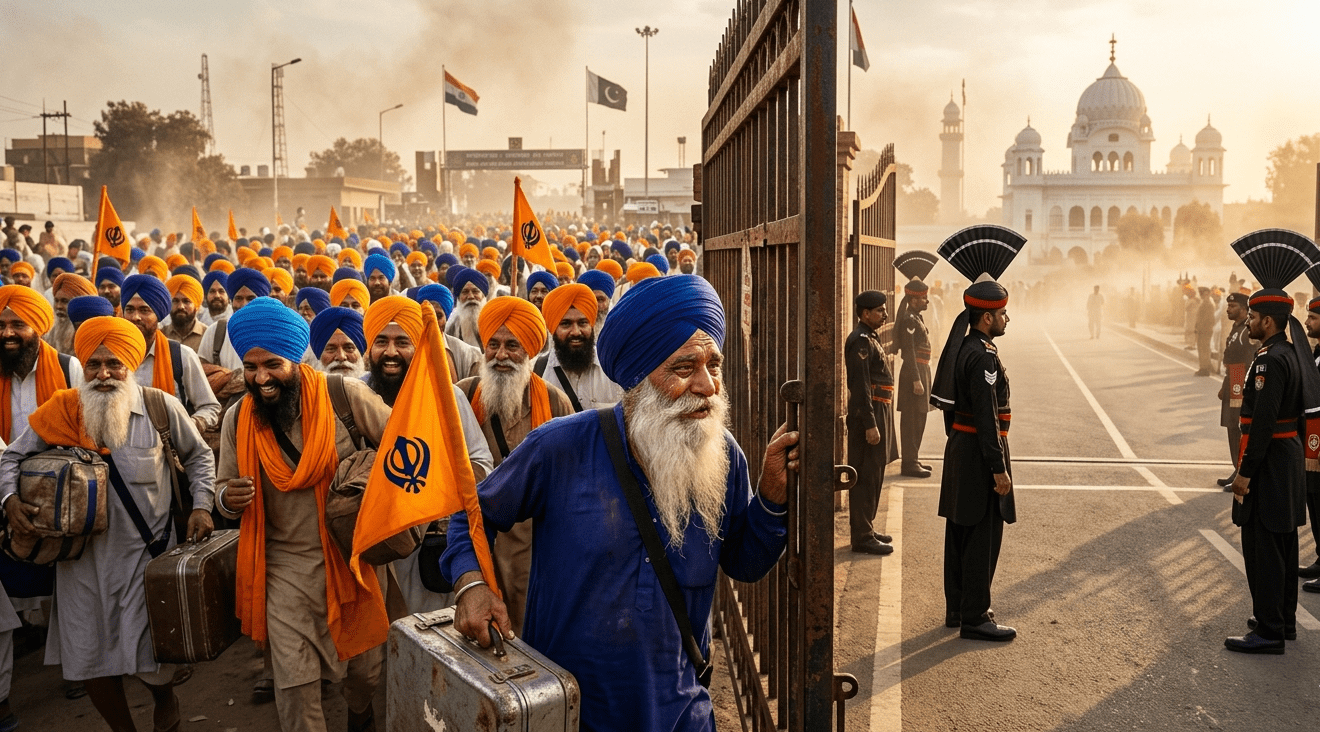
If you stand at the Wagah border on a quiet morning, you can almost feel the weight of the air. It is a thick, humid mix of tense history and shared breath. But in just ten days, on April 10, that air is going to change. The static silence of the “No Man’s Land” will be replaced by the scent of marigolds, the heat of thousands of bodies in motion, and the rhythmic, chest-thumping sound of “Jo Bole So Nihaal.”
Nearly 3,000 Indian Sikh pilgrims are currently in the final stages of packing. They are tucked away in the bustling lanes of Amritsar, the quiet villages of Gurdaspur, and the high-rises of Delhi, checking their passports for the third time today. They are preparing to cross into Pakistan for Baisakhi 2026. For many, this isn’t just a “visit” or a religious obligation. It is a return to the very roots of a faith that were suddenly, violently cut off by a ink-stroke on a map in 1947.
More Than Just a Number
I was reading through a report from Lahore this morning where officials were scrambling. The energy in the newsrooms across the border is palpable. They are setting up extra immigration counters, preparing specialized medical camps, and coordinating with the Pakistan Sikh Gurdwara Parbandhak Committee (PSGPC). They are expecting a massive influx.
Why 3,000? That is the specific ceiling agreed upon under the 1974 bilateral protocol between India and Pakistan. But numbers, as any storyteller knows, are a poor way to measure the human heart.
The real story is the elderly man from a small pind in Punjab who has spent thirty years waiting for this specific visa stamp to see Nankana Sahib, the birthplace of Guru Nanak. Or consider the twenty-something digital creator from Chandigarh who has only ever seen the majestic domes of Gurdwara Panja Sahib through the grainy, faded photographs kept in her grandfather’s wooden trunk. For these 3,000 individuals, the Wagah crossing isn’t a political checkpoint; it is a bridge over a river of ancestral memories.
The Geography of Disconnect
To understand why this journey is so significant in 2026, you have to understand the geography of the Sikh faith. The core of Sikh history is split across a border that didn’t exist for the first 450 years of the religion’s life.
Imagine if your family home was suddenly in a different country, and you needed a diplomatic miracle just to visit the room where you were born. That is the reality for the Sikh community. Nankana Sahib, the site of the Guru’s birth; Panja Sahib, where the miracle of the handprint occurred; and Kartarpur Sahib, where Guru Nanak spent his final years farming and teaching—these are all in Pakistan. Yet, the vast majority of the Sikh population resides in India.
Every year, when the visa lists are finalized, there is a mix of jubilation and heartbreak. For every one of the 3,000 who got the nod this year, there are ten others who will stand at the border fence in India, looking through binoculars toward a horizon they aren’t allowed to touch.
The Route: A Spiritual Odyssey
The schedule for the 2026 Jatha is grueling, but there is a strange beauty in the endurance it requires. It isn’t meant to be a luxury tour; it is a pilgrimage in the truest sense.
The Crossing: April 10
The journey begins at the Wagah-Attari border. This is the moment of maximum friction and maximum release. Pilgrims walk across the line, luggage in hand, transitioning from one sovereign state to another. The atmosphere here is always a strange blend of military precision and religious fervor.
The Destination: Hasan Abdal (April 12–14)
After the initial entry and logistics in Lahore, the pilgrims head north to Hasan Abdal. This is the site of the main event: the Baisakhi festival at Gurdwara Panja Sahib.
If you have never seen Panja Sahib during Baisakhi, it is hard to describe the scale of it. It is a sea of saffron and bright yellow turbans. The air is cool around the natural spring, and at the center of it all is that famous boulder. According to tradition, Guru Nanak stopped a falling rock with his bare hand while a local sage tried to crush him. The handprint is still there, smoothed by centuries of devotees touching it in prayer. Standing in that courtyard in 2026, surrounded by thousands of voices chanting in unison, the political borders don’t just feel distant; they seem to dissolve entirely.
The Heart of the Faith: Nankana Sahib
After the high energy of Panja Sahib, the group travels to Nankana Sahib. This is a place of profound quiet and gravity. It is the Janam Asthan—the birthplace. For a Sikh, being here is like finding the source code of their entire existence. The architecture is grand, but the feeling is intimate. It is here that the pilgrims often spend the most time in silent meditation, reflecting on the universal message of “Ik Onkar”—the One Reality.
The Final Leg: Kartarpur and Lahore
Before returning to India on April 20, the Jatha will visit Gurdwara Darbar Sahib in Kartarpur. Since the opening of the Kartarpur Corridor, this site has become a symbol of hope. It is the place where Guru Nanak discarded the robes of a traveler and lived as a simple farmer, teaching that honest labor is as sacred as prayer.
The Logistics of Love (and Safety)
We often talk about “geopolitics” as something that happens in high-rise offices between men in suits. But “Pilgrim Diplomacy” is the grassroots version of that.
The PSGPC and the Evacuee Trust Property Board (ETPB) have been in high-level meetings for weeks. In a region where infrastructure can be unpredictable, they have promised “uninterrupted gas and electricity” for the pilgrims. This might sound like a small detail, but in the context of the current regional climate, it is a significant gesture of hospitality.
They have also established “zero tolerance” security zones. It is a heartbreaking reality of 2026 that a journey of peace requires such heavy protection, but the commitment to keeping the pilgrims safe is one of the few areas where both governments seem to find a common, silent understanding.
There is an interesting paradox here. Even when official diplomatic channels between New Delhi and Islamabad are frosty, or when trade is at a standstill, the “faith corridors” remain open. It’s a reminder that people-to-people connections have a stubborn, almost annoying way of surviving even the coldest political winters.
Baisakhi: A Harvest of History
At its surface, Baisakhi is a harvest festival. It marks the ripening of the rabi crops and the beginning of a new solar year. But for the Sikh community, the harvest is much deeper.
It was on Baisakhi in 1699 that Guru Gobind Singh Ji called for a gathering at Anandpur Sahib and created the Khalsa. He transformed a community of seekers into a community of “Saint-Soldiers.” He gave them a distinct identity, the Five Ks, and a mandate to stand up against tyranny.
When these 3,000 pilgrims board their buses and trains next week, they aren’t just celebrating a change in the weather. They are harvesting their own history. They are reclaiming an identity that was forged in fire and remains unbowed by the fences of the 20th century.
The Digital Pilgrimage
For those of us who didn’t make the list of 3,000, 2026 offers a different kind of connection. We live in an era where the “Sikh Yatra” will be livestreamed on YouTube and documented in real-time on X and Instagram.
I expect to see thousands of “Reels” from the streets of Lahore and the sarovar at Panja Sahib. This digital footprint is vital. It allows the global Sikh diaspora—from Canada to the UK to Australia—to participate in the journey. It turns a physical crossing of 3,000 people into a spiritual crossing for millions.
There is something deeply grounding about watching a livestream of an old woman bowing before the Nishan Sahib in a country she hasn’t seen since she was a child. In a world that feels increasingly divided by algorithms and echo chambers, these moments of raw, unfiltered human faith act as a necessary anchor.
Final Thoughts: The Unbroken Chain
As the sun sets on the Wagah border tonight, the gates are closed, and the soldiers are at their posts. But in the hearts of those 3,000 travelers, the gate is already open.
They represent a link in a chain that stretches back over five centuries. A chain that wasn’t broken by the Mughal Empire, wasn’t broken by British colonialism, and wasn’t broken by the Partition of 1947.
The 2026 Baisakhi Yatra is a testament to the fact that you can divide the land, you can divide the water, and you can even divide the people. But you cannot divide a prayer. When the first bus rolls across that line on April 10, it won’t just be carrying passengers; it will be carrying the hope that one day, the borders we build will be as temporary as the dust behind a pilgrim’s feet.
FAQ: Navigating the 2026 Baisakhi Yatra
Q: What are the exact dates for the 2026 Jatha? The pilgrims are scheduled to enter Pakistan on April 10, 2026, and return to India via the Wagah-Attari border on April 20, 2026.
Q: Why is Panja Sahib the focus of Baisakhi in Pakistan? While Nankana Sahib is the birthplace of the Guru, Panja Sahib is where the massive Baisakhi “Mela” and primary religious congregational prayers have traditionally been held for centuries. It is the spiritual epicenter of the spring festival.
Q: Can Indian pilgrims visit Kartarpur during this trip? Yes. While the Kartarpur Corridor allows for day-trips without a visa for some, the official Baisakhi Jatha includes a multi-day itinerary that specifically stops at Gurdwara Darbar Sahib as part of the broader tour.
Q: What should pilgrims carry? Authorities recommend carrying minimal luggage, valid identity documents, and essential medicines. Most importantly, pilgrims are advised to carry Indian currency that can be exchanged at designated counters in Lahore or at the border.
Q: Is it safe for solo travelers? The Baisakhi Jatha is a highly organized group event. Pilgrims travel in “Jathas” (groups) with heavy security coordination. It is generally not a “solo” backpacking trip but a managed community movement.